Which Trade Shows Are Worth Exhibiting At? A Data-Driven Selection Guide
"We went last year, so we'll go again" is the most expensive habit in an events budget. Visitor composition, cost per lead, and your own event data — the criteria and checklist for choosing shows worth your booth.
"We exhibited last year, so we'll exhibit again" is the most expensive habit in a trade show budget. Add up the booth fee, build-out, staffing, and travel, and one show is never a small line item — yet "is this show right for us?" is often decided by feel. This guide covers the criteria for choosing which shows to exhibit at, and how to make the re-exhibit decision from your own data after the first run.
Show selection decides half your outcome
Run the best booth in the world — if your customers aren't in the hall, good leads won't appear. At the right show, even a modest booth fills the pipeline. The order matters: where you stand comes before how you decorate.
Three things to check on first evaluation:
- Are the visitors your customers? Composition, not volume. Ask the organizer for the industry and job-role breakdown of visitors. "50,000 total visitors" matters less than the share involved in buying decisions.
- Do competitors and adjacent players exhibit? Competitors re-exhibiting year after year is evidence the market works there. If no competitor attends at all, suspect "no customers here" before "untapped opportunity."
- Is the event itself healthy? Are exhibitor counts and visitor numbers holding or growing across recent editions, and what does the organizer actually do to bring visitors in?
Look at total cost, not the booth fee
Comparing shows by booth fee alone skews the decision.
| Cost item | Notes |
|---|---|
| Booth fee | Varies by location and size — on whether premium placement pays, see the booth timing strategy guide |
| Build-out | Graphics, furniture, power, internet — first-time exhibitors tend to overspend here |
| Staffing | Wages plus the opportunity cost of the work that stops while your team is away |
| Travel | Transport, lodging, meals — items multiply for overseas shows (overseas expo checklist) |
| Before and after | Pre-show outreach, materials, and the follow-up hours after closing |
Divide total cost by expected leads and you get a cost per lead. For a first-time show, estimate conservatively from organizer figures and comparable events; for a repeat, use your own last-run numbers. Compare that cost per lead with your other channels — digital ads, outbound — and for the first time "is this show expensive?" has a numeric answer.
The re-exhibit decision — your last run holds the answer
Deciding whether to return should rest on records, not impressions. In the post-show report, look at three things:
- Lead volume and temperature mix: the hot/warm share matters more than the total. A pile of cold leads means the visitor mix wasn't yours.
- How far the leads went: weeks after the show, what share turned into meetings, quotes, or deals? A show's real report card is issued the following quarter, not on closing day.
- Daily and hourly patterns: if the final day is consistently empty, exhibiting for fewer days is a legitimate option next time.
All of this requires complete records during the show. The metric framework is covered in the event ROI metrics guide.
The decision checklist
- Visitor industry/role mix overlaps our target (confirmed with organizer data)
- Competitors or adjacent players have a re-exhibit history
- Event scale and visitor numbers are stable or growing
- Cost per lead on total cost is defensible against our other channels
- The purpose fits in one sentence (new leads / existing-customer touchpoint / brand / market research)
- An invitation list for pre-booked meetings exists (pre-show meeting strategy)
- On-site recording and post-show follow-up are set up
If more than half the boxes are empty, attending as a visitor first — without a booth — is a respectable decision. Walking the show costs a fraction of exhibiting and answers most of these questions firsthand.
Collect this year's evidence for next year's decision — TagBooth
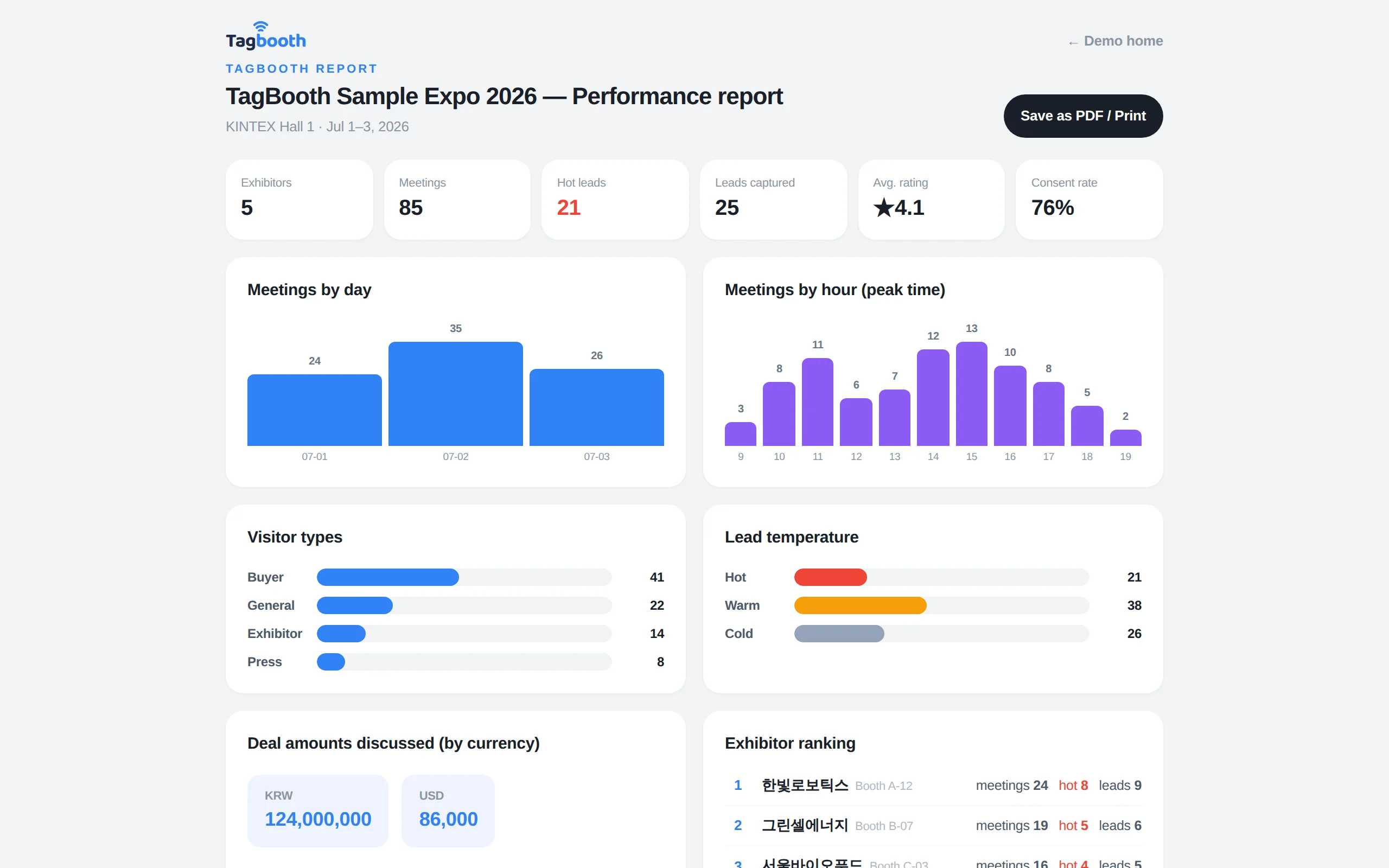
The re-exhibit decision ultimately rests on this year's records. TagBooth captures a 30-second consultation log per visitor — temperature, rating, and interests as tap-in chips — and when the event ends, builds a report with daily and hourly charts, temperature distribution, and company rankings, exportable to PDF and Excel.
As reports accumulate show by show, "which trade shows are right for us?" becomes a year-over-year comparison of data rather than a debate of impressions — this article's checklist filled in with records instead of guesses. See a sample report in the demo without signing up; the full flow is in how it works.
FAQ
We're entering a new market — which show should we start with?
Walk the sector's flagship show as a visitor first. Seeing the visitor mix, how busy competitor booths actually are, and the organizer's operational quality tells you more than any brochure. If the walk-through convinces you, start with a small booth at the next edition.
Are bigger shows always better?
No. A specialist show with 5,000 visitors of whom 30% are your buyers often beats a general fair with 50,000 visitors of whom 1% are — on cost per lead. General fairs lean toward brand exposure; specialist shows lean toward lead capture. Choose by your stated purpose.
What's a good cost per lead?
There's no absolute number — normal ranges vary by industry and deal size. What matters is the comparison against your own other channels, and the year-over-year trend at the same show. If the cost rises every year while lead quality stays flat, that's a review signal.
Budget is tight — what do we cut first?
Cut booth size and build-out before people and before pre/post-show work. A small booth with prepared staff and booked meetings produces; a large booth with an unprepared team only spends. Exhibiting for fewer days is also a sound cut when your day-by-day data supports it.